
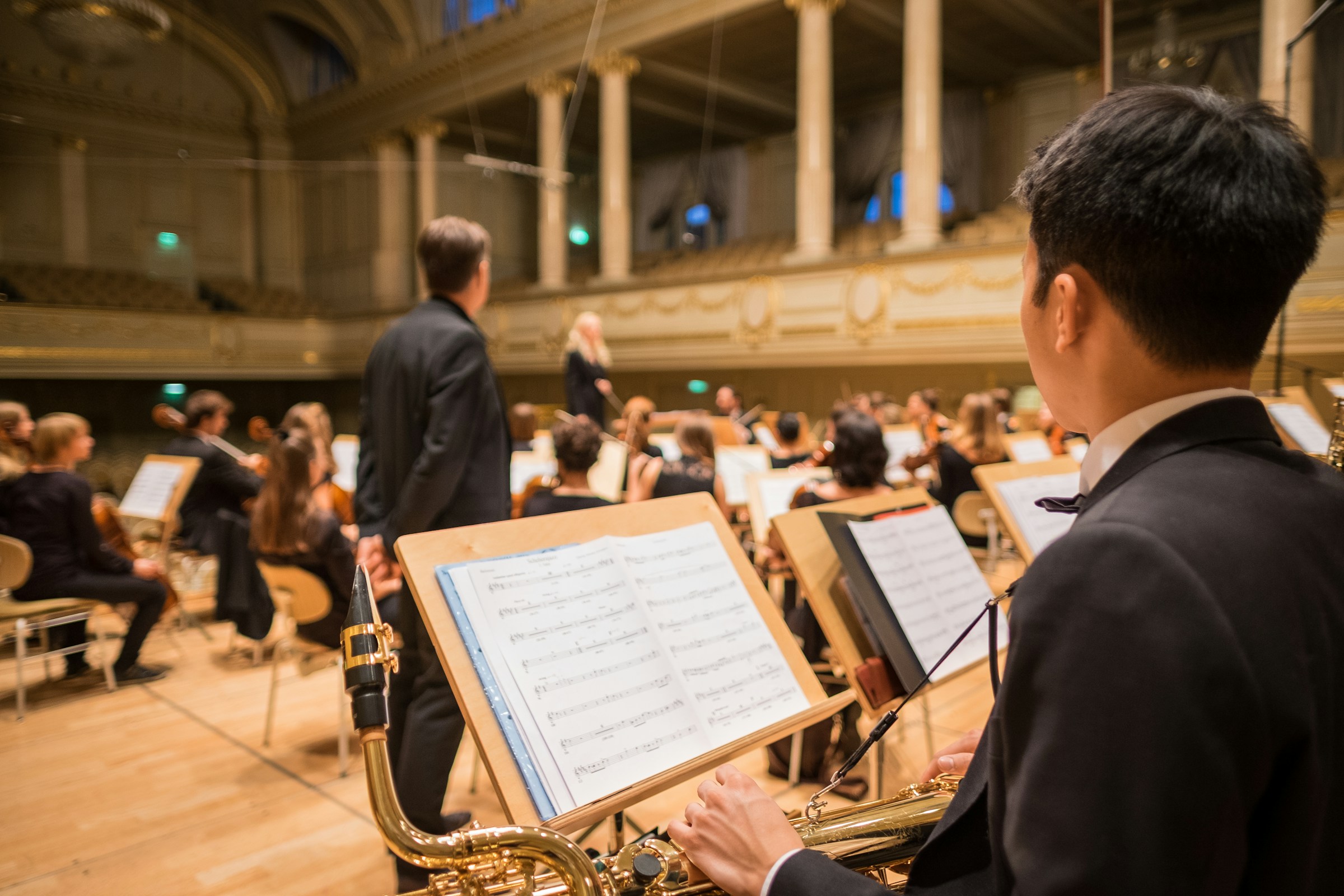
Photo by Manuel Nägeli on Unsplash
Music Festival Judging: What Adjudicators Actually Listen For
Festival judging often feels mysterious, especially when you aren’t sure what adjudicators are listening for. Yet most festival rubrics share common categories. Understanding those categories allows you to prepare students more strategically and improves the overall festival experience for everyone. The following guide dives into the core elements of festival evaluation—tone, intonation, rhythm, technique, interpretation, ensemble blend and professionalism—and offers practical teaching strategies for each. The content draws from widely used judging rubrics to help you align your preparation with what adjudicators actually hear.
Tone Quality and Sound Production
Tone is the foundation of every performance. Judges listen for a characteristic, vibrant sound that is free of tension and well-controlled. Great tone draws the listener in and sets the stage for other elements like intonation and expression.
- Prioritize long tones. Begin rehearsals with long-tone exercises to build breath support and embouchure strength. Sustained tones develop the muscle memory necessary for a consistent, beautiful sound.
- Model great sound. Play professional recordings or demonstrate your own tone so students have a clear benchmark for quality. Encourage them to imitate both the timbre and the way that sound is produced.
- Encourage critical listening. Ask students to listen to each other and describe what makes a tone “good.” Peer feedback encourages intentional listening and fosters awareness of tone quality across the ensemble.
A strong, resonant tone helps every other aspect of the performance fall into place.
Intonation and Pitch Accuracy
Intonation—how well performers play in tune—is often assessed separately from tone quality. Even the most beautiful tone falls short if it is not in tune with the ensemble. To improve pitch accuracy:
- Tune with purpose. Use drones, tuners or apps to help students hear pitch relationships. Encourage them to adjust proactively, not just when asked.
- Develop ear training. Incorporate singing and interval recognition exercises so students learn to identify when notes are sharp or flat. Ear training builds internal pitch memory.
- Check chords and octaves. Tune unisons, octaves and chords within the ensemble, not just individual instruments. Balance and harmony depend on these vertical pitch relationships.
Regular attention to intonation instills habits that carry over into performances.
Rhythm and Tempo Control
Rhythmic accuracy and steady pulse are critical parts of festival rubrics. Judges evaluate how well the ensemble maintains tempo, navigates transitions and executes complex rhythms. Strengthen rhythmic precision by:
- Practicing with a metronome. Vary metronome settings—downbeat only, subdivision or offbeat clicks—to challenge students’ internal timing. Gradually reduce metronome dependence.
- Counting and clapping. Remove instruments and clap tricky rhythms or speak counts together. This isolates rhythmic challenges without technical distractions.
- Rehearsing transitions. Work specifically on ritardandos, accelerandos, fermatas and tempo changes so they feel natural and unified across the group.
A strong rhythmic foundation reduces anxiety and keeps the ensemble together under pressure.
Technique and Articulation
Technique encompasses everything from attacks and releases to fingering/bowing facility. Many rubrics break technique into sub-elements like articulation, accent placement and missed notes. Develop technique by focusing on:
- Isolating articulation patterns. Practice tonguing, slurring and varying attack styles in scales or short exercises. Consider call-and-response drills to reinforce consistency.
- Emphasizing fingering/bowing accuracy. Slow down passages to identify and correct inefficient fingerings or bowings. Gradually increase speed as accuracy improves.
- Matching articulations. Ask students to listen across the section and match each other’s attacks and releases. Encourage a unified approach within and between sections.
Strong technique gives performers the freedom to express musical ideas clearly and confidently.
Musical Expression and Interpretation
Interpretation and musicianship make up a large part of many adjudication scores. Balance, phrasing, dynamics, style and emotional connection all fall into this category. Encourage expressive playing by:
- Highlighting dynamics. Use the full dynamic range (from pianissimo to fortissimo) and shape phrases with crescendos and decrescendos. Remind students that dynamics convey emotion and direction.
- Creating clear phrases. Discuss the “sentences” within the music and where the natural breaths occur. Encourage students to think about the story they are telling and plan their phrases accordingly.
- Balancing voices. Adjust dynamics so that melodies project and accompanying parts support. Encourage students to listen across the ensemble to achieve balanced textures.
Encouraging expressive playing helps performances transcend the mechanical and become truly engaging.
Ensemble Blend, Balance and Cohesion
Blend and balance refer to how well individual sounds mix and how evenly voices are distributed. Rubrics often evaluate blend, balance and sense of ensemble. Improve cohesion by:
- Listening across the ensemble. Have students shift their focus from themselves to the group. Ask them to adjust their sound to fit into the overall texture rather than compete with it.
- Practicing chorales. Chorales encourage careful listening, matching tone and pitch, and balancing parts. They provide a musical context for working on blend.
- Responding to cues. Encourage eye contact with the conductor for entrances, cut-offs and expressive gestures. A responsive ensemble reacts quickly and cohesively.
A unified ensemble sound leaves a lasting impression on judges and audiences alike.
Performance Etiquette and Stage Presence
Stage deportment—students’ posture, appearance and professionalism—is part of some adjudication forms. Demonstrating respect for the performance space and the audience adds polish to a program. Prepare students by:
- Rehearsing entrances and exits. Practice walking on and off stage calmly, setting up efficiently and acknowledging applause. The way performers take the stage sets the tone for the performance.
- Maintaining professional posture. Encourage upright posture and focused attention, even when not playing. A poised appearance conveys confidence and readiness.
- Projecting confidence. Teach students to make eye contact with the audience and avoid fidgeting or unnecessary movement. Confidence onstage often translates to confidence in playing.
Good stage presence complements musical preparation and demonstrates respect for the event.
Preparation and Rehearsal Strategies
Well-prepared ensembles consistently achieve higher festival ratings. Judges notice when groups are under-rehearsed or unprepared. Strengthen preparation by:
- Simulating festival conditions. Run through pieces without stopping and with limited warm-up time to mimic festival timing. This helps students get comfortable performing under pressure.
- Holding mock adjudications. Invite another teacher or advanced student to listen and provide feedback based on judging criteria. Mock performances highlight areas needing improvement.
- Recording and reviewing. Listen to rehearsals and performances. Students often hear issues on recordings that they don’t notice while playing. Use these insights to plan focused practice sessions.
Deliberate preparation builds confidence, reduces anxiety and leads to more polished performances.
Final Thought
Festival success isn’t about chasing perfect scores. It’s about helping students perform with confidence, clarity and musical intent. By focusing on tone, intonation, rhythm, technique, expression, ensemble cohesion and professionalism, you align your preparation with the criteria adjudicators actually listen for. This approach not only produces better scores but also helps students grow as musicians.
Dr. Scott Jeppesen, DMA
Founder, Wolfgang
Associate Professor of Music
See How Wolfgang Handles This Automatically
Wolfgang gives educational festivals modern tools for registration, scheduling, adjudication, and payments — all in one platform.
Get festival management tips in your inbox